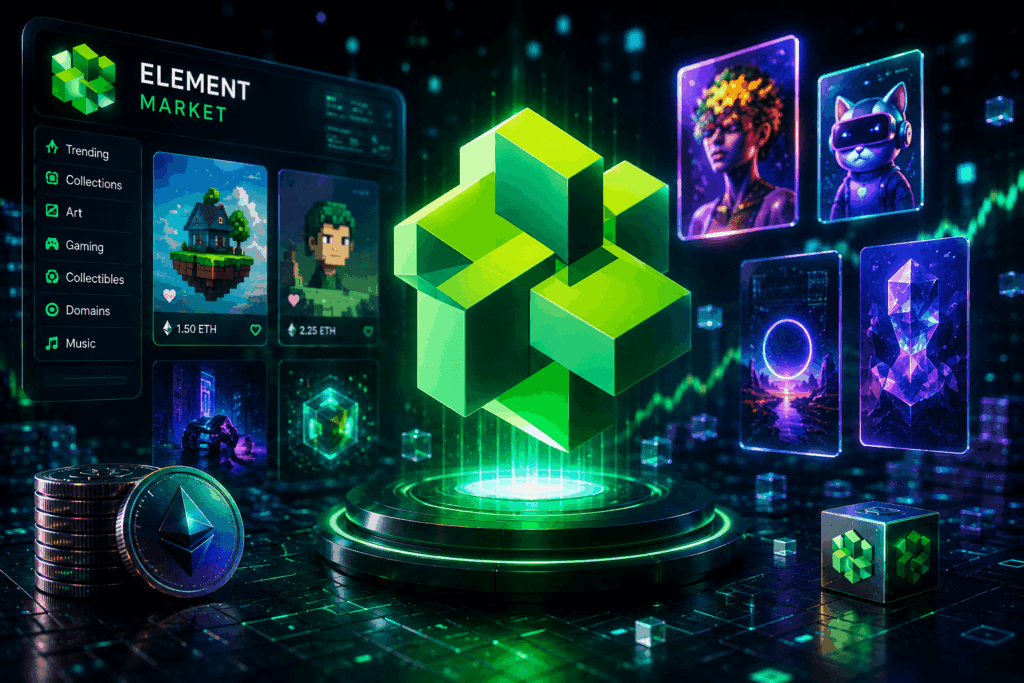
Before I ever opened Element Market for the first time, I had a completely wrong picture of what this platform actually was. I thought it was just another copy of OpenSea that I would never use. Then I opened the site, browsed around, and realized it was something different – a tool that has actually saved me money on every transaction, while also showing me opportunities I never even noticed on other marketplaces.
In this article, I’ll explain exactly that – what Element Market is, how it works, and above all, how you can use it to actually earn money with crypto. I won’t drag on with theory. I’ll go straight into practice, step by step, so that by the end of the article you’ll know how to open the platform and make your first moves on your own.
If you’re a complete beginner and terms like “wallet”, “gas fee” or “mint” confuse you – don’t worry. I’ll explain every term as we go, so you won’t have to search the internet for what it means.
Before we dive into Element Market, let me say that understanding the basics of crypto is key if you want to earn long-term in this field. I’ve condensed all the basics you need for a safe start into my free crypto e-book, which I recommend reading before you start investing any money.
What Is Element Market?
Element Market is a marketplace for NFTs (Non-Fungible Tokens – a unique digital certificate of ownership proving that a particular digital image, item, or file is yours and cannot be duplicated). In practice, think of Element Market as a kind of “Craigslist” for digital goods built on blockchain technology (a chain of data blocks that records all transactions publicly and cannot be altered).
What sets Element Market apart from the competition is that it’s a so-called aggregator – meaning the platform gathers listings from several different NFT marketplaces in one place (for example OpenSea, LooksRare, X2Y2, and others). So when you’re looking for a particular NFT, Element Market shows you the lowest price, regardless of which platform the listing is actually on. It’s like having a single search engine that compares airline ticket prices across ten different sites at once, instead of having to check each site separately.
In addition, Element Market supports an exceptionally large number of networks (chains or networks – individual blockchains such as Ethereum, BNB Chain, Polygon, and others, which operate independently of one another). This means you can trade NFTs from more than twenty different blockchain networks on a single platform, which saves you a huge amount of time, since you don’t have to switch between ten different sites.

Why Use Element Market Instead of OpenSea?
In one of my previous articles, I introduced you to OpenSea, the largest and best-known NFT marketplace in the world. So why would you need Element Market at all?
The answer is simple – saving money and a better overview of opportunities. When you buy or sell an NFT, you always pay what’s called a “gas fee” (a network fee you pay to miners or validators to record your transaction on the blockchain). Element Market is built to optimize these costs, and for bulk purchases (when you buy several NFTs at once) it can save you up to half of your gas fees compared to buying them one by one on traditional platforms.
In addition, Element Market offers features you won’t find as easily on OpenSea – for example, detailed rankings of collections by volume, number of buyers, and price movement, which helps you find profitable opportunities faster. I’ll go into more detail on this below.
How to Get Started: Setting Up a Wallet
Before you can buy or sell anything on Element Market, you need a crypto wallet (a digital application or browser extension that stores your cryptocurrencies and lets you sign transactions). The most popular choice among beginners is MetaMask, which I also covered in detail in one of my previous articles, and Trust Wallet works great as well.
Once you have your wallet installed and some cryptocurrency in it (for example ETH – Ether, the main cryptocurrency of the Ethereum network), simply visit element.market and click the wallet icon in the top right corner to connect your digital wallet to the platform. This process is the same as the one you already know from other exchanges and marketplaces – but never enter your seed phrase anywhere other than your own wallet, because otherwise it can be stolen.
If you’re curious which wallets and exchanges I recommend for a complete start in the world of crypto, I explain all the steps in my free crypto e-book, where you’ll also learn how to store your funds safely.
Choosing the Right Network (Blockchain) on Element Market
When you first land on the platform, you’ll notice a button in the top menu showing the current network (for example, “Ethereum”). If you click it, a dropdown list opens with dozens of different networks – from Ethereum, BNB Chain, Polygon, Base, and Arbitrum to lesser-known ones like Linea, Starknet, Mantle, Monad, and many others.
Why does this matter? Each of these networks has its own NFT collections, its own prices, and its own community. Some networks, such as Ethereum, have higher gas fees, but also more established and valuable collections. Other, newer networks, such as Base or Monad, have significantly lower transaction costs, which means you can try out more opportunities with a smaller investment, without spending all your money on fees alone.
My practical tip for beginners: if you’re just starting out and have a limited budget, begin on a network with lower gas fees (for example, Polygon or Base), where you can gain experience with smaller amounts before moving on to Ethereum, where stakes and costs are higher.
Collection Ranking – How to Find Opportunities Before Others Do
In my opinion, this is one of the most important features on the entire platform if you’re interested in actually earning money, not just collecting digital art as a hobby.
When you click “Ranking” in the top menu, you’ll see an overview of all collections, sorted by volume, price, and other stats. Here you have two views available:
- Trending – shows you the collections that have been getting the most attention and trading activity lately. These are collections that are currently “hot,” with the most buying and selling going on.
- Top – shows you the biggest and most established collections by total volume or market value.
In the ranking table, you’ll see the following data, which you need to understand if you want to make smart decisions:
- Floor Price – the lowest price at which an NFT from a given collection is currently for sale. This is an important indicator of how much the collection is currently worth on the market.
- Volume – the total value of all transactions in a given time period (for example, the last 24 hours). Higher volume means greater interest and liquidity (meaning it will be easier to sell your NFT, if you decide to do so later).
- Sales – the number of transactions in the selected period.
- Buyers – the number of unique buyers. If the number of buyers is low compared to sales, it may mean the same people are buying multiple times (which can be a sign of artificially inflated volume).
- Listed – the percentage of all NFTs in the collection that are currently for sale. A low percentage (for example, under 5%) often means that owners believe in future price growth and aren’t selling.
A practical example from the table: if you see a collection where volume jumped by +1,000% in a single day and the number of buyers is rising at the same time, it means the collection has suddenly attracted a lot of attention. This can be an opportunity, but also a warning – sudden spikes can be the result of genuine community interest, but they can also be short-term speculation, where the price drops again after a few days. That’s why you should never invest money you can’t afford to lose, and always research a collection first before putting your money in.
Gas Fee Settings – How Not to Overpay
When you decide to make a purchase, Element Market offers you a choice between three transaction processing speeds:
- Standard – the cheapest option; the transaction is processed a bit more slowly.
- Fast – faster processing for a slightly higher fee.
- Rapid – the fastest processing, but also the most expensive option.
My tip for beginners: unless you’re buying something where every minute counts (for example, an extremely popular collection that is selling out its NFTs quickly), always choose the “Standard” option. This saves you money, and in the vast majority of cases the transaction is processed within a few minutes even at the lowest price.
Swap Function – Exchange Cryptocurrencies Without Leaving the Platform
Element Market also has a built-in “Swap” function, which you can find in the top menu. This function lets you exchange one cryptocurrency for another directly on the platform – for example, ETH for USDC (a stablecoin whose value is pegged to the U.S. dollar, so 1 USDC is always worth approximately 1 USD).
This is extremely convenient, because you don’t have to leave the site and go to another exchange if, for example, you want to convert part of your profit from selling an NFT into a more stable form of money. The function is powered by LI.FI, an external provider for swapping cryptocurrencies between different networks, so it’s a proven and secure technology used by many platforms.
If you’re wondering why it’s important to convert part of your profit into stablecoins and how doing so protects your capital from market fluctuations, I explained it in detail in my free crypto e-book
How to Create Your Own NFT Collection (Create a Drop)
Element Market isn’t just for buying and selling – it also lets you create (mint) your own NFT collection. The word “mint” in the crypto world refers to the process of recording a digital file on the blockchain for the first time, thereby creating a unique, one-of-a-kind NFT.
The process is surprisingly simple, even for someone with no technical programming knowledge:
- In the top menu, click “Create” and then choose the option to create a drop or collection (Drop).
- Choose the network (for example, Ethereum) where you want your collection to live. For each network, the platform immediately shows you an estimate of the costs (gas fee), which helps you pick the most affordable option.
- Enter the name of your collection and a short abbreviation (symbol), similar to stock tickers on an exchange.
- Upload an image or file that represents your collection (the platform supports formats such as PNG, JPG, GIF, and even 3D files).
- Write a description of your collection that will explain to readers and potential buyers what it’s all about.
This is a great opportunity for anyone with artistic or design skills who wants to monetize their work in a completely new way, without the need for galleries or middlemen.
How to Actually Earn with Crypto Through Element Market
Now that you know the platform’s basic features, let’s talk about what interests you most – how to actually make money with it. Here are a few strategies that I use myself and that I recommend to beginners:
1. Following trends and getting in early. Using the “Trending” tab, you can spot collections that are just starting to gain attention. If you get in early, while the price (floor price) is still low, and the collection later gains popularity, you can sell your NFT at a profit. This takes research and involves some risk, so never invest more than you’re prepared to lose.
2. Taking advantage of price differences between marketplaces. Because Element Market is an aggregator, you can sometimes notice that the same NFT is cheaper on one marketplace than on another. By buying at the lower price and selling at a higher price on another platform, you can make a profit – in the crypto world, this is called arbitrage.
3. Creating and selling your own NFTs. If you have artistic skills or access to AI tools for creating digital images, you can create your own collection, as I described above, and sell it to collectors around the world.
4. Watching the “whales.” In the world of crypto and NFTs, the term “whale” refers to an investor with a very large amount of capital who can move the price of an entire collection with their purchases or sales. Element Market offers statistics on the number of buyers, which indirectly helps you assess whether you’re looking at organic growth or manipulation by larger players.
5. Low entry price (Listed %). As I mentioned above, a low percentage of NFTs currently for sale often means that owners believe in future growth. These are collections worth adding to your Watchlist, which is also available on the platform.
All of these strategies require a basic understanding of the crypto market, so I strongly recommend that before your first real investment, you read my free crypto e-book, where I also explain how to manage risk and how to set realistic goals.
Security Tips You Need to Follow
Before I wrap up, I have to stress a few security rules that every beginner needs to know:
- Never share your private phrase (seed phrase) with anyone, not even platform support. No legitimate platform will ever ask you for it.
- Verify the official website – always make sure you’re on the right domain (element.market), since there are many fake copies of the site designed to steal your funds.
- Start with smaller amounts. When trying out a new platform, never put in all of your savings. First, get familiar with the features using a smaller amount that is acceptable to you.
- Use a hardware wallet for larger amounts. For storing larger sums of crypto, it’s significantly safer to use a physical device such as a Ledger, rather than keeping everything solely in a browser wallet.
Frequently Asked Questions About Element Market
Is Element Market safe to use? Element Market is an established platform, backed by well-known investment funds from the crypto world. As with any decentralized platform, though, the security of your funds largely lies in your own hands – take care to secure your wallet and never share your private information.
Do I need a lot of money to start using Element Market? No. You can start with small amounts, especially if you choose a network with low gas fees, such as Polygon or Base. The goal at the beginning is not an immediate profit, but understanding how the platform works.
How does Element Market differ from OpenSea? The main difference is that Element Market is an aggregator that collects listings from multiple marketplaces at once, which often means lower prices and lower transaction costs. In addition, it supports significantly more blockchain networks.
Can I also sell my cryptocurrencies on Element Market, not just NFTs? Yes, the platform has a “Swap” feature that lets you exchange one cryptocurrency for another without leaving the site.
How much can I actually earn trading NFTs? That depends on your knowledge, your research, and the risk you’re willing to accept. Nobody can guarantee you a profit, so it’s crucial to educate yourself first and start with smaller amounts.
Mistakes it’s smart to avoid:
Mistake #1: Buying purely out of FOMO (Fear Of Missing Out). When you see that a collection’s trading volume has jumped by several hundred percent in a single day, the temptation to buy immediately is huge. But right when interest is at its peak, the price is often at its highest too. It’s often better to wait for the dust to settle a bit, and only then assess whether the collection is actually worth the money you’d put in.
Mistake #2: Ignoring liquidity. Liquidity refers to how easily you can convert your asset (in this case an NFT) back into cash or another cryptocurrency. If you buy an NFT from a collection with very low trading volume, you may later find that you simply can’t sell it because there are no buyers. Always check the “Volume” and “Buyers” columns in the ranking table before you decide to buy.
Mistake #3: Ignoring gas fees on smaller purchases. If you’re buying an NFT worth a few tens of euros on a network with high fees, you may end up paying almost as much for the transaction itself as the NFT is worth. For smaller amounts, always consider cheaper networks such as Polygon or Base.
Mistake #4: Too much concentration in a single collection. Just as with traditional investing, the rule of spreading your risk (diversification) applies here too – don’t put all your available money into a single project, no matter how promising it looks at first glance.
How to fit Element Market into a broader crypto strategy
Element Market is not a magic solution for making money by itself – it’s a tool, one of many you can use in your work with cryptocurrencies. Especially when you want to:
- quickly compare NFT prices across multiple marketplaces at once,
- find collections that are gaining momentum before they go mainstream (become widely known),
- save on gas fees when buying several NFTs at once,
- or when you want to swap cryptocurrency within a single platform without extra steps.
If you’re only just starting down this path and don’t know which step to begin with – an exchange, a wallet, or maybe directly with an NFT marketplace – I recommend that you first build a solid foundation of knowledge. I’ve put all of this together in my free crypto e-book, where I explain step by step how to set up the right order of steps, whether you’re more interested in long-term investing or active NFT trading.
Conclusion
Element Market is one of the platforms that offers you, as a beginner in the world of cryptocurrencies and NFTs, much more transparency than many other marketplaces – from a clear overview of collection rankings to customizable gas fee settings and support for dozens of different blockchain networks.
As I said at the beginning, the key to success isn’t rushing and investing money without understanding – the key is to educate yourself first, start with small steps, and gradually build your knowledge and your portfolio.
If you want to have all these basics in one place and learn how to start your journey into the world of cryptocurrencies smartly and safely, download my free crypto e-book – in it, I’ve revealed everything I’ve learned in all my years working in this field.